
OCD Treatment for Children & Adolescents in Bahawalpur

Helping young people break free from overwhelming thoughts and rituals.
Obsessive-Compulsive Disorder (OCD) can affect a child’s confidence, schoolwork, family life and everyday routines. Unwanted thoughts and repetitive rituals often create a cycle of anxiety and temporary relief. At Rafaa Center in Bahawalpur, our child psychology team provides individualised assessment, CBT-informed treatment, gradual exposure and response-prevention strategies, and practical family guidance.
OCD is more than wanting things to be perfect.
Unwanted thoughts can lead to rituals that take over daily life.
Obsessions are unwanted thoughts, images or urges that cause anxiety or discomfort. Compulsions are repetitive actions or mental rituals a child feels driven to perform for temporary relief.
A child might repeatedly check homework, wash their hands, arrange items, ask for reassurance or silently repeat phrases. Relief lasts briefly, then doubt returns. Many children hide these experiences because they fear being misunderstood.
Psychological assessment at Rafaa Center explores what the child is experiencing, how long the pattern has continued, the effect on school or family life, and how to help the child feel confident without relying on rituals.

What OCD symptoms can look like in children.
Not all rituals are visible. Some take place silently in the mind. The amount of distress and disruption matters more than any single habit.
Intrusive thoughts
Recurring, unwanted worries about germs, harm, making mistakes or something going wrong.
Checking and washing
Repeated checking of schoolwork or doors, excessive handwashing or cleaning to feel safe.
Mental rituals
Silently counting, repeating words, reviewing events or trying to cancel out a frightening thought.
Constant reassurance
Repeated questions or relying on family members to complete or confirm rituals.
Avoidance
Staying away from places, people, objects or activities that trigger obsessive fears.
Disrupted routines
Spending excessive time getting ready, completing work or leaving the house because of rituals.
Different children experience OCD differently.
Contamination fears: Worry about dirt, germs or illness may lead to washing, cleaning or avoidance.
Checking and doubt: Fear of mistakes or danger can result in repeated checking, questioning or reviewing.
Symmetry and ordering: Some children rearrange objects, count or repeat movements until things feel just right.
Unwanted intrusive thoughts: Disturbing thoughts about harm, religion or morality can be especially upsetting. Such thoughts do not mean the child intends to act on them.
Hidden compulsions: Mental counting, silent repetition or repeatedly asking others for reassurance may be missed by adults.
Understanding the full picture: Ordinary routines, developmental differences and careful habits are not automatically OCD. Assessment considers age, duration, distress and everyday functioning.
When a five-minute task becomes a long ritual.
Understanding the pattern makes change possible.
A child may check their schoolbag again and again, worried that forgetting one item could cause something bad. A parent checks it as well and the child feels better, but the relief fades quickly. The same doubt returns the next morning.
OCD treatment helps children recognise the cycle of worry, ritual and temporary relief. Structured, manageable practice teaches a different response to uncertainty. Parents are guided to support the child warmly while gradually reducing the repeated reassurance that maintains the cycle.
Through child and adolescent psychology services, Rafaa Center supports the emotional and behavioural difficulties that can accompany OCD.
For children whose thoughts and rituals are affecting everyday life.
Rafaa Center supports children and adolescents experiencing intrusive thoughts, compulsive rituals, avoidance, distress and disruption in school or family routines.
How psychological therapy helps children manage OCD.
Individual assessment: The psychologist explores obsessions, compulsions, emotional distress, developmental needs, school functioning and family experiences. Together, the child and family develop meaningful goals.
Cognitive Behavioural Therapy (CBT): Age-appropriate CBT helps children understand thoughts, anxiety, behaviours and the ways compulsions can maintain distress.
Exposure and Response Prevention (ERP): ERP is a central evidence-based approach to OCD. With structured professional support, children practise approaching safe situations that trigger worries while reducing the usual ritual. Activities follow a gradual and achievable plan.
Family involvement: Parents learn how to respond calmly, recognise OCD patterns and support gradual reduction of repeated reassurance or participation in rituals.
School and daily routines: Therapy goals can include completing homework, improving concentration, reducing morning delays and becoming more independent in everyday activities.
Progress reviews and coordinated care: Treatment is adapted over time. For severe symptoms, psychiatric assessment and medical treatment can be coordinated alongside psychological care. Families can also explore child mental health assessment at Rafaa Center.
Four steps towards confidence and flexibility.
Practical goals are adapted to each child’s developmental stage, symptoms and strengths.
Recognise OCD patterns
Understand which thoughts, fears and actions are part of the OCD cycle.
Plan achievable practice
Develop a gradual hierarchy of safe situations to approach without the usual rituals.
Respond differently
Practise tolerating uncertainty and reducing compulsive responses in manageable steps.
Strengthen daily life
Build independence, school participation and family strategies that reinforce progress.
What happens during child OCD treatment?
Our child psychology team follows a clear process that combines understanding, practical therapy and caregiver involvement.
Initial consultation
01 · LISTEN
We explore the child’s intrusive thoughts, repeated behaviours, distress and their effects on school, relationships and family life.
Personalised treatment plan
02 · PLAN
Together, we identify treatment goals and suitable CBT and graduated response-prevention exercises.
Child-focused therapy
03 · PRACTISE
Guided activities help the child respond to worries and rituals differently, supported by useful parent strategies.
Progress and family review
04 · GROW
We review distress, independence, daily routines and coping skills, adjusting the plan as the child progresses.
Meet the professional supporting children and families.
Areeda Amjad is a Clinical Psychologist at Rafaa Center specialising in child and neurodevelopmental concerns. Her clinical work includes psychological assessment, emotional and behavioural difficulties, CBT-informed support and parent guidance. She helps children and families understand distressing thoughts, anxiety-related patterns and daily-life challenges.
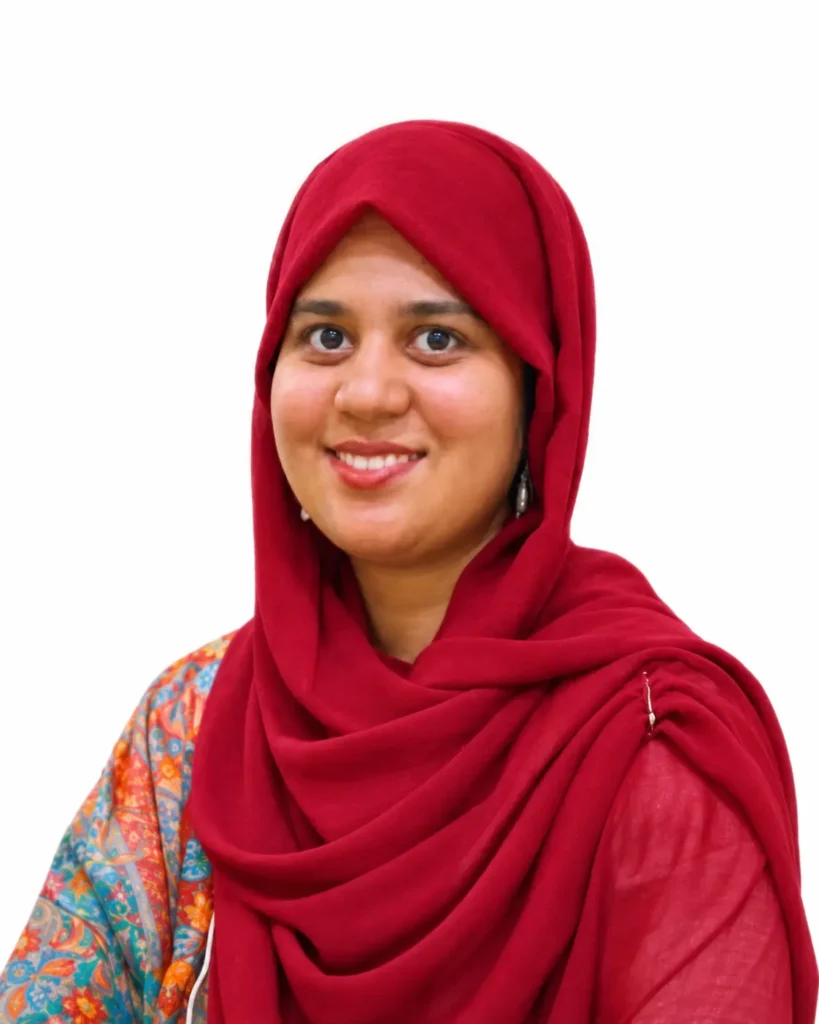
Areeda Amjad
Clinical Psychologist · Child & Neurodevelopment
Clinical psychologist supporting children and adolescents through psychological assessment, emotional and behavioural care, and family guidance.
Questions about child OCD treatment in Bahawalpur.
Answers about intrusive thoughts, CBT, ERP, family guidance and helping children with repetitive rituals.
Where can I find OCD treatment for children in Bahawalpur?
Rafaa Center provides child psychological assessment, CBT-informed support and family guidance for children experiencing intrusive thoughts, repetitive rituals and related anxiety. Contact the team to book a consultation.
Is OCD in children the same as OCD in adults?
The core pattern of unwanted obsessions and compulsions is similar, but children often need age-appropriate explanations and active family involvement.
How can I tell whether my child has OCD or just a habit?
Ordinary routines are common. OCD involves distressing, repeated thoughts or rituals that take up time and interfere with school, family life or everyday functioning.
What are common signs of OCD in children?
Repeated checking, washing, counting, mental rituals, intrusive worries, avoidance and frequent reassurance-seeking are common examples.
Can intrusive thoughts occur without a child wanting to act on them?
Yes. Intrusive thoughts are unwanted and can be frightening. Having a distressing thought does not mean the child intends to act on it.
What is CBT for childhood OCD?
Cognitive Behavioural Therapy helps children understand how thoughts, anxiety and repeated behaviours interact, then practise more helpful responses.
What is Exposure and Response Prevention (ERP)?
ERP involves gradual practice with safe anxiety-provoking situations while learning not to complete the usual compulsion. Activities are planned collaboratively.
Does ERP work for children?
CBT including ERP is an evidence-based first-line treatment for children and teenagers with OCD. Progress depends on individual symptoms and engagement.
Will my child have to stop rituals all at once?
Therapy uses an age-appropriate, gradual plan. Goals are discussed with the child and caregivers and adjusted as progress develops.
How should parents respond to repeated reassurance-seeking?
Parents can respond warmly while following a consistent care plan that reduces repeated checking or reassurance over time.
Can OCD interfere with school?
Yes. Intrusive thoughts, compulsive checking, anxiety or perfectionism can affect homework, concentration, attendance and everyday routines.
Does childhood OCD always require medication?
No. CBT including ERP is a key treatment. When symptoms are severe or remain disruptive, psychiatric assessment may consider medication alongside psychological care.
Can OCD occur alongside anxiety or developmental concerns?
Yes. Assessment considers possible anxiety, mood, attention and developmental difficulties so the support plan addresses the child’s full needs.
How long does child OCD treatment take?
The number of sessions varies according to symptoms, daily-life impact, family involvement and progress. Treatment goals are reviewed regularly.
How do I book a child OCD consultation at Rafaa Center?
Use rafaacenter.com/contact-us/ to arrange a consultation with Rafaa Center’s child psychology team in Bahawalpur.
Help your child move beyond OCD.
Understanding and practical support for everyday confidence.