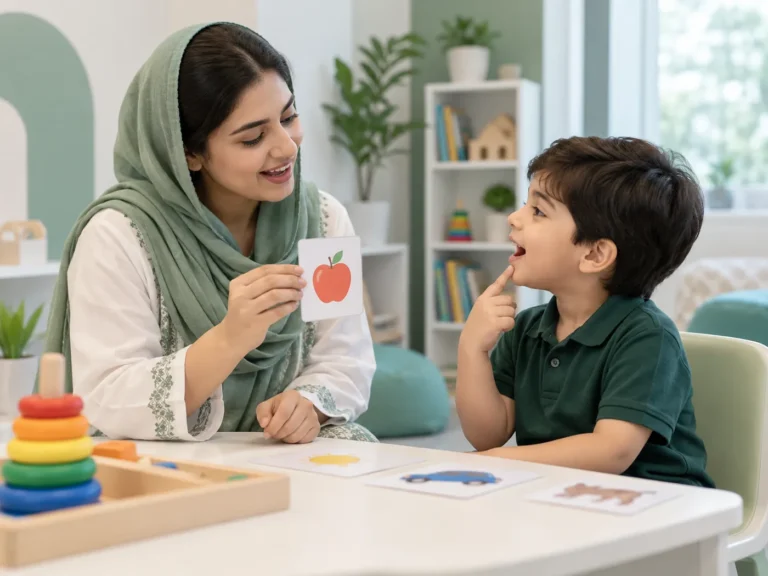
Reading, writing, spelling and maths struggles are not proof that a child is lazy. Notice persistent patterns, talk to teachers, provide skill-specific support and ask about an appropriate assessment when learning or confidence is affected.
Not every child who struggles at school needs to try harder. If reading takes much longer than expected, spelling remains difficult or basic maths feels confusing even after practice, your child may need a different kind of learning support. Understanding comes before judgement.
Learning difficulties in children can affect reading, writing, spelling, mathematics and confidence. One child may explain a lesson clearly but struggle to read the textbook. Another may understand spoken instructions but find it hard to organise written answers. At Rafaa Center in Bahawalpur, child psychology and neurodevelopmental support begins by understanding each child’s strengths, difficulties and learning environment.
This parent-friendly guide explains seven signs worth noticing, what dyslexia and dyscalculia mean, when assessment may help and simple ways to support learning at home and school.
What Are Learning Difficulties in Children?
Learning difficulties are challenges with developing particular academic skills, such as accurate reading, spelling, written expression or understanding numbers. A child may need more time, different instruction or a specialist assessment to understand why these skills remain hard.
A specific learning disorder is a more precise term used when a qualified assessment identifies significant and persistent difficulties with particular academic skills. Dyslexia is commonly associated with word reading and spelling, while dyscalculia relates to understanding numbers and mathematical concepts. Not every child who struggles in a subject has a diagnosable condition.
Learning differences do not mean that a child is lazy, unintelligent or unwilling to succeed. Some children have strong creative, verbal, social or practical skills while needing targeted support with written schoolwork.
7 Signs of Learning Difficulties in Children
These signs are starting points for a conversation with a teacher or professional. They are not a diagnosis by themselves. What matters is the pattern, your child’s age and learning opportunities, and how much the difficulty affects everyday life.
1. Reading takes much longer than expected
Your child may read word by word, guess unfamiliar words, lose their place in a sentence or avoid reading aloud. They may understand a story well when listening to it but struggle to decode the same text independently.
2. Spelling remains difficult despite practice
The same word may be spelled differently several times. A child may leave out letters, confuse speech sounds or find it hard to remember which letters make a particular sound. Repeated spelling struggles deserve support, not embarrassment.
3. Writing does not match what your child can explain
Some children can tell a thoughtful story but find writing a paragraph exhausting. Organising sentences, handwriting, spelling and expressing ideas are different skills. A useful assessment looks at which part is creating the difficulty.
4. Numbers and quantities are confusing
A child may count aloud but find it hard to connect the number seven with seven objects. They may struggle to compare quantities, recognise number patterns or understand what a place value means.
5. Basic maths facts are hard to remember or use
The child may repeatedly forget simple addition facts, mix up mathematical symbols or find estimating an answer difficult. Memorising multiplication tables does not always mean the underlying number concepts are understood.
6. Homework causes unusual frustration or avoidance
A child may become upset before reading assignments, take far longer than classmates or say, “I’m stupid.” This response may come from frustration, anxiety, a learning difference or a combination of factors. It should prompt a supportive conversation.
7. There is a clear gap between strengths and academic tasks
Your child might solve practical problems, speak confidently and remember spoken stories while finding written tests or maths exercises very difficult. Noticing both strengths and difficulties can help teachers plan more effective support.
The British Dyslexia Association describes reading and writing patterns that parents and teachers may notice. No single example should be used to label a child.
Dyslexia: Understanding Reading and Spelling Difficulties
Dyslexia primarily affects accurate and fluent word reading and spelling. Some children struggle to connect letters with sounds, read unfamiliar words or develop automatic word recognition. Dyslexia is not simply writing letters backwards, and its presentation can differ from child to child.
Example: A student understands a science topic when the teacher explains it, but reading the textbook independently takes so much effort that the meaning gets lost. More pressure to read faster is unlikely to help. Identifying which reading skills need direct teaching is more useful.
The NHS guidance on dyslexia in children explains that assessment can clarify learning strengths and needs. The International Dyslexia Association recommends structured literacy, with explicit and systematic reading and spelling instruction for students who struggle with these skills.
If your child uses both Urdu and English at home or school, explain their language exposure and teaching history to the assessor. Learning in more than one language is not itself a disorder, but it is important context for understanding a child’s reading development.
Dyscalculia: When Learning Maths Is More Than a Struggle
Dyscalculia involves persistent difficulties understanding and using numbers or quantities. It can affect number sense, estimation, remembering number facts and applying mathematical concepts. It is not the same as simply disliking maths or occasionally making calculation errors.
Example: A child can say numbers in order but struggles to give a parent exactly six blocks. Later, they may find comparing numbers, working with money or telling time unusually difficult.
The British Dyslexia Association’s dyscalculia guidance explains that not all maths difficulties are dyscalculia. A professional considers educational history, the specific number skills involved and other factors that may affect learning.
Could Something Else Be Affecting School Progress?
Yes. A child may have missed important lessons, need more suitable teaching, or be learning academic material in a less familiar language. Attention difficulties, anxiety, communication differences, sleep problems and hearing or vision concerns may also contribute.
Learning difficulties can occur alongside other developmental concerns, but one condition should never be assumed from a few school observations. If the child has school-related stress, our back-to-school anxiety guide offers practical parent conversations. If emotional outbursts or behaviour are prominent, see our child behaviour and parent guidance guide.
When Should Parents Request a Learning Assessment?
Consider asking for guidance when reading, writing or maths difficulties continue despite suitable teaching and practice, interfere with school progress, or are affecting your child’s confidence. You do not need to wait until a child feels completely defeated at school.
Start with a conversation with the class teacher. Ask which skills are difficult, what the school has tried, and whether the child progresses with targeted instruction. Keep a few examples of schoolwork to discuss rather than focusing only on exam marks.
What Happens During a Child Psychological or Neurodevelopmental Assessment?

The process depends on the child’s age and needs. A professional may talk with parents and the child, review developmental and school history, consider information from teachers, observe learning or behaviour and recommend appropriate assessment methods. The goal is to understand what is difficult and why.
- Share the learning history: When did the difficulty become noticeable, and has it changed over time?
- Bring real examples: Reading samples, writing, maths work, school reports and teacher feedback.
- Discuss development and wellbeing: Attention, language, sleep, emotional reactions and relevant health concerns.
- Ask about assessment scope: Which skills or conditions can be assessed, and is a specialist referral needed?
- Agree on next steps: Targeted classroom support, parent strategies, further evaluation or referral where appropriate.
An initial psychological consultation or screening is not necessarily a formal dyslexia or dyscalculia diagnostic assessment. Specialist educational or psychoeducational testing may be required. Ask exactly what a service can assess before booking.
At Rafaa Center, the published child and neurodevelopmental team includes Areeda Amjad, whose scope includes school and academic learning concerns, child assessment and parent guidance. Rafaa Center can confirm the available assessment services and whether additional specialist testing is appropriate.
5 Practical Ways to Help Your Child Learn With Confidence
1. Ask what feels hard instead of telling them to work harder
Try saying, “Which part confused you?” or “Would you like to show me where you got stuck?” This makes it easier to identify a problem without making the child feel ashamed.
2. Break school tasks into manageable steps
A long worksheet can be divided into smaller parts. Give clear instructions and short breaks when needed. More repetitions are not always helpful if a child has not understood the underlying skill.
3. Match the teaching method to the difficulty
For reading, ask teachers about systematic instruction in sounds, letters and word decoding. For maths, concrete objects, number lines and visual examples may help children understand quantities and relationships.
4. Work with teachers on practical adjustments
Children may benefit from targeted lessons, clearer instructions, alternative ways to demonstrate understanding, or extra time when appropriate. The best plan depends on the child’s actual learning profile.
5. Appreciate strengths beyond grades
Celebrate curiosity, effort, kindness and progress. A child should feel valued because of who they are, not only because of academic marks. Confidence matters when learning is already difficult.
How Schools Can Support Children With Learning Difficulties
Schools can observe specific academic skills, communicate regularly with parents and provide extra instruction based on the child’s needs. A student struggling with reading benefits from skilled reading instruction, not simply more pages to finish. A student struggling with numbers may need concrete, visual demonstrations rather than repeated memorisation alone.
Avoid comparing the child’s work publicly with classmates. Clear feedback, realistic learning goals and a supportive classroom can make it easier for students to ask questions and keep trying.
Child Learning Assessment and Psychology Support in Bahawalpur
Parents searching for learning difficulties in children in Bahawalpur can speak with a child psychologist about persistent reading, writing or maths concerns. Rafaa Center lists child psychology and neurodevelopmental assessment support, including guidance for families dealing with school difficulties.
Areeda Amjad and the Rafaa Center team can help parents understand the appropriate next step. Learn about the center’s approach to assessment and care or read about Rafaa’s psychological support services in Bahawalpur. Availability of formal dyslexia or dyscalculia diagnostic testing should be confirmed directly.
To request a child psychological assessment, contact Rafaa Center or call/WhatsApp 0311 4522233. Address: House No. 5, Street No. 4, Muhammadia Colony, Bahawalpur, Pakistan. Bring any relevant school feedback and ask which professional and assessment type are appropriate.
Frequently Asked Questions
What are the early signs of learning difficulties in children?
Signs can include unusually slow reading, frequent spelling problems, difficulty writing ideas, confusion with basic numbers and persistent frustration with school tasks. They do not confirm a diagnosis without an appropriate assessment.
Is dyslexia a sign of low intelligence?
No. Dyslexia affects reading and spelling skills and can occur in children with a wide range of abilities. It does not measure a child’s intelligence or worth.
How is dyscalculia different from being weak in maths?
Dyscalculia involves persistent difficulties understanding numbers and quantities. Other maths difficulties may relate to missed teaching, anxiety or different learning needs.
Should I book an assessment if my child struggles in only one subject?
It depends on how persistent or significant the difficulty is, and what support has already been tried. A teacher and qualified professional can help decide whether specialist assessment is useful.
Can Rafaa Center diagnose dyslexia or dyscalculia?
Rafaa Center offers child psychological and neurodevelopmental assessment support, but the availability of formal dyslexia or dyscalculia diagnostic testing has not been confirmed. Contact the clinic about appropriate assessment or referral options.
Where can I find a child psychologist for learning difficulties in Bahawalpur?
Rafaa Center’s child and neurodevelopmental team includes Areeda Amjad, whose published areas include school and academic learning difficulties. Ask the center about appointment availability and the appropriate assessment pathway.
Rafaa Related Guides & Services
Parents may also find these related childhood development guides useful: back-to-school anxiety and parent guidance, understanding challenging behaviour in children, and early communication skills before talking.
For a professional assessment of learning needs, explore Dyslexia & Learning Support and Child IQ & Cognitive Assessment.