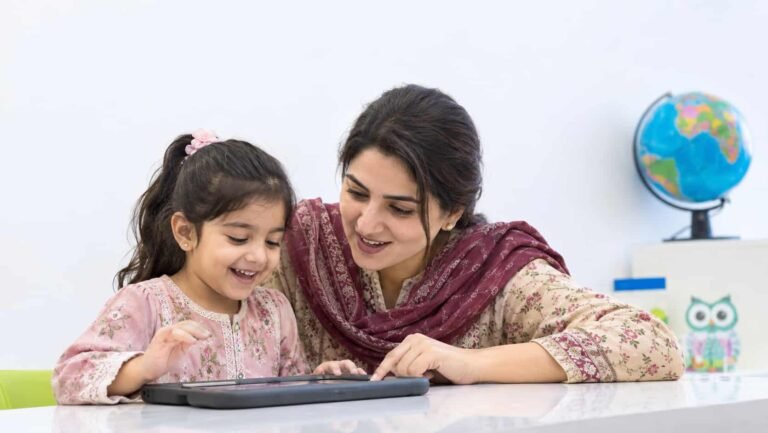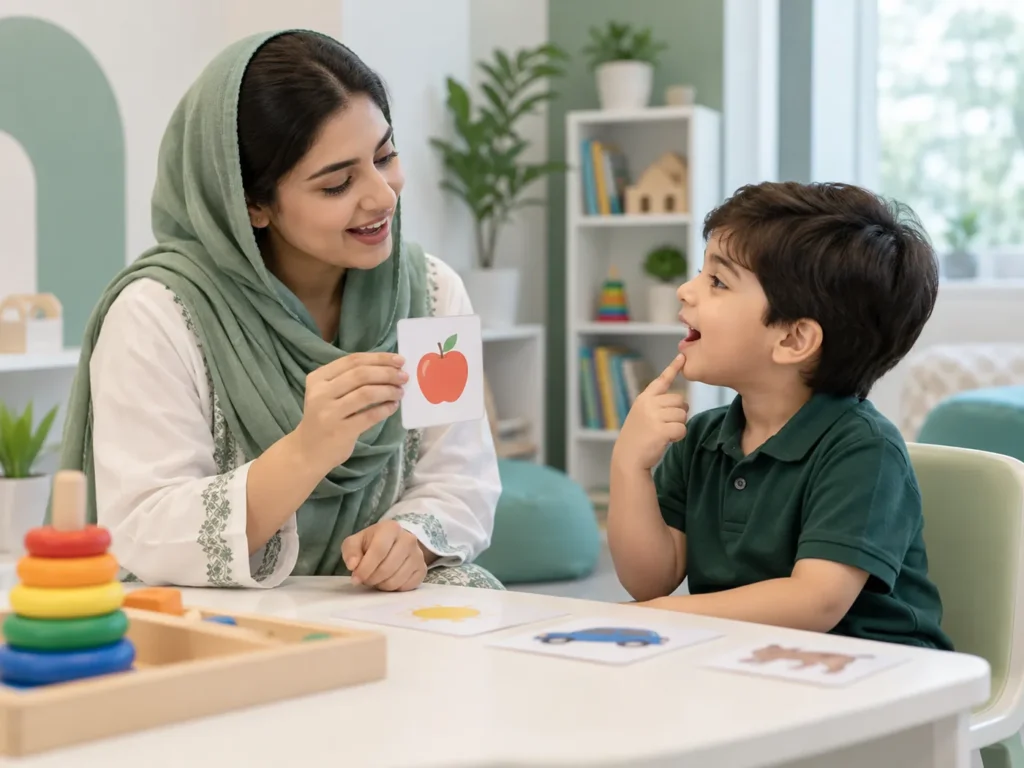
Children communicate before words through gestures, expressions, initiation, shared attention, imitation, responses to their surroundings and turn-taking. Encourage these skills through responsive play, and request a speech-language assessment if communication is delayed or skills are lost.
Children begin communicating long before they say their first words. A baby may look towards a familiar voice, smile when someone smiles, reach for a favourite toy or start a simple back-and-forth game. These everyday moments are early communication, even without spoken language.
These abilities are often called pre-linguistic skills or pre-verbal communication skills. They help children share attention, express feelings, connect with people and develop the foundations for later language. At Rafaa Center in Bahawalpur, helping families understand early communication is an important part of our speech and language development guidance.
The image behind this guide identifies eight key skills: responding to the environment, eye contact, facial expressions, initiation, gestures, joint attention, imitation and turn-taking. Here is what each means in everyday life, along with simple activities parents can try without turning playtime into a test.
What Are Pre-Linguistic Skills in Child Development?
Pre-linguistic skills are ways babies and young children communicate before they can reliably use words and sentences. They include noticing sounds and people, responding through expressions or movement, using gestures, sharing interests and taking turns in playful interactions.
The American Speech-Language-Hearing Association (ASHA) describes early social communication behaviours such as responding to voices, following another person’s attention, using gestures, copying actions and participating in back-and-forth interactions. These skills do not develop in exactly the same way or at the same pace for every child.
Early communication does not need to look like prolonged face-to-face interaction. Children may communicate through sounds, facial expressions, body movements, pointing, looking towards objects, showing things, or alternative communication methods. What matters is understanding how the child connects, communicates and responds.
8 Pre-Linguistic Skills to Notice Before a Child Starts Talking
1. Responding to the Environment
A child notices what is happening nearby. They may turn towards a familiar sound, pause when someone speaks, react to a sudden noise, look for a caregiver or show interest in a toy moving across the room. The response may be small and depends on age, attention, hearing and sensory needs.
Try at home: Use a gentle, familiar voice during play. Say the child’s name once, then allow time to respond. You can also use a favourite toy that makes a soft sound. Observe whether they notice or respond, without repeating commands or startling them.
If a child does not reliably respond to sounds, hearing should be considered as part of developmental evaluation. A child may hear some sounds but still need a formal hearing check.
2. Eye Contact and Looking Towards Others
Many babies naturally look at familiar faces or glance towards a person during interaction. Looking can help them notice expressions and understand where another person’s attention is focused. However, direct eye contact is not a requirement for communication, and some children, including autistic children, may communicate comfortably without looking into another person’s eyes.
Try at home: Sit where your child can easily see you, follow their interest and offer a warm expression when they look your way. Do not hold their face, repeatedly demand “look at me,” or treat forced eye contact as a therapy goal.
A child’s communication should be understood as a whole. Eye contact alone cannot confirm or rule out autism, speech delay or any other developmental difference.
3. Facial Expressions
A smile, frown, surprised look or change in expression can tell us how a child feels before they have the words to explain it. Babies may smile back at familiar people, and children often notice changes in a caregiver’s tone or expression.
Try at home: Smile naturally during a shared game, make a playful surprised face or pause during a nursery rhyme. Notice how your child responds. Different children express emotions differently, so avoid judging a child by how expressive their face appears.
4. Initiation: Starting Communication
Initiation means that the child begins an interaction rather than always waiting for an adult. They may make a sound to get attention, reach towards something, bring a toy, approach a caregiver, point to an object or invite someone into a game.
Try at home: Put two familiar toys within sight and wait to see which one your child chooses. Respond when they reach, gesture, vocalise or show an interest. Acknowledge the attempt with a simple phrase such as “You want the ball.”
Initiation can happen without speech. Gestures, pictures and other accessible communication methods deserve the same respect as spoken requests.
5. Gestures: Communicating Without Words
Gestures include reaching, pointing, waving, showing, giving, shaking the head and raising arms to be picked up. They help a child express needs and share attention before spoken language becomes reliable.
For example, a child may point to a cup to request water or hold up a toy to show someone what they found. The ASHA milestones for birth to one year include gestures, showing and giving objects among early communication behaviours.
Try at home: Model a wave when someone leaves, point towards a familiar object while naming it, and respond when your child uses a gesture. Do not require the child to speak before meeting an important need.
6. Joint Attention: Sharing Interest in Something
Joint attention happens when a child and another person share attention around an object, event or activity. The child may point towards an aeroplane and look to see whether a parent noticed, show a favourite toy, or shift their attention between a person and an interesting object.
Try at home: Follow what your child is already interested in. If they notice a bird outside, look towards it and say, “A bird! It’s flying.” Avoid constantly directing them to objects they do not find interesting. Shared enjoyment matters more than getting the child to perform a particular response.
Differences in joint attention can be worth discussing with a developmental professional when they occur alongside other concerns, but a single observation is not a diagnosis.
7. Imitation: Learning Through Copying
Imitation includes copying a gesture, movement, sound or simple play action. A baby might copy a clap or playful sound. A toddler may imitate stirring with a spoon or placing a toy in a box. Children learn through watching, experimenting and playing together.
Try at home: Copy your child’s own sounds or actions first, then introduce a simple variation if they seem interested. Clap during a song, tap a toy drum or roll a ball back and forth. Keep it enjoyable and stop when your child wants a break.
Not every child imitates in the same way. Some prefer watching, moving or exploring objects independently. Encourage interaction without demanding exact copying.
8. Turn-Taking: The Beginning of Conversation
Turn-taking is the back-and-forth pattern of communication. Before words, it can be two people exchanging smiles, sounds, gestures or playful actions. Later, the same rhythm supports conversations, listening and responding.
Try at home: Roll a ball to your child and wait for their response. Pause during peekaboo, or echo a sound the child makes and allow time for them to respond again. A short, comfortable interaction is more useful than a long forced activity.
You do not need to teach all eight skills at once. Notice what your child already enjoys and build on those moments.
When Do Early Communication Skills Usually Develop?
Development is gradual and not identical for every child. The broad examples below are helpful observations, not a complete developmental assessment or rigid pass/fail timetable.
- Birth to 6 months: Babies increasingly notice voices and faces, use cries and early sounds, smile socially and begin simple exchanges with caregivers.
- Around 6 to 12 months: Many babies babble, respond to familiar voices, enjoy social games and begin using gestures such as reaching, showing or waving.
- Around 12 to 18 months: Many children use more gestures, point or show objects, share interests and begin combining emerging words with nonverbal communication.
- Beyond 18 months: Children usually build more intentional communication, understanding and spoken or alternative language, while differences in development remain possible.
For age-specific information, use the ASHA communication milestones and the CDC developmental milestones rather than expecting every child to develop in exactly the same order.
5 Simple Ways to Support Pre-Linguistic Skills at Home
- Follow your child’s lead. Join the toy, book or activity they have chosen instead of constantly directing play.
- Respond to all communication attempts. A reach, gesture, sound or picture selection can carry real meaning. Acknowledge it.
- Use short, natural language. Say “The car is moving” or “More water?” during actual routines rather than repeatedly asking the child to copy words.
- Pause and give time. Allow a few comfortable seconds after your turn in a game. Children do not always respond immediately.
- Build communication into daily life. Mealtimes, dressing, outdoor walks and shared play offer more natural opportunities than repeated drilling.
Parents do not need expensive toys or constant screen-based exercises. Simple, responsive interactions can create useful opportunities for connection. The goal is not to pressure a child into a performance, but to make communication accessible and enjoyable.
When Should Parents Be Concerned About Speech Delay?
Parents should consider a professional discussion if their child rarely communicates needs or interests, uses few gestures, has difficulty understanding or responding to everyday communication, does not seem to notice sounds, or shows a loss of previously acquired communication skills. Concerns about social interaction, hearing or overall development are also reasons to ask for guidance.
The National Institute on Deafness and Other Communication Disorders (NIDCD) explains that speech or language concerns may warrant a speech-language assessment and that hearing evaluation is often part of understanding a delay.
A speech delay is not automatically autism. Likewise, pre-linguistic differences cannot be diagnosed from an infographic or a checklist alone. A qualified clinician considers the child’s hearing, developmental history, communication strengths and needs.
If your child has lost words or communication skills they previously used, seek a prompt clinical evaluation rather than waiting for the next school term. Support can be considered before a formal diagnosis is established.
What Happens During an Early Communication Assessment?
A speech and language professional may ask about the child’s developmental history, language exposure, hearing and everyday routines. They may observe play, gestures, sound-making, understanding of language, turn-taking, joint attention and the way your child communicates with familiar people.
Parents may be invited to demonstrate everyday interactions or describe examples from home. A clinician may recommend an appropriate hearing evaluation, developmental assessment, parent guidance, individualised speech-language support or another referral based on findings.
At Rafaa Center, Shiza Anum is listed as a Speech and Language Pathologist with an MS in Speech & Language Pathology. Her published areas of support include language delays, social communication and autism-related communication needs. The child and neurodevelopmental team also includes Areeda Amjad for relevant developmental and psychological concerns.
Speech Therapy and Early Communication Support in Bahawalpur
If you are searching for speech therapy in Bahawalpur, child speech delay assessment or guidance on pre-linguistic skills in children, Rafaa Center provides a starting point for discussing a child’s communication needs. The team can confirm whether a speech-language assessment, parent guidance or developmental referral is appropriate.
The center is at House No. 5, Street No. 4, Muhammadia Colony, Bahawalpur, Punjab. To enquire about an appointment, contact Rafaa Center or call/WhatsApp 0311 4522233. Confirm clinician availability and the type of assessment before visiting.
For more information, see Rafaa Center’s speech and language services, read our guide to AAC and autism communication tools, or explore child and family support services in Bahawalpur.
Frequently Asked Questions About Pre-Linguistic Skills
What are pre-linguistic skills?
Pre-linguistic skills are ways children communicate before they reliably use spoken words. Examples include gestures, facial expressions, responding to voices, initiating interaction, sharing attention, imitation and taking turns.
What are the 8 pre-linguistic skills?
The eight skills discussed in this guide are responding to the environment, eye contact or looking towards others, facial expressions, initiation, gestures, joint attention, imitation and turn-taking. They are useful areas to observe, not a diagnostic scoring system.
Does a child need eye contact to develop speech?
No. Children may communicate effectively using gestures, sounds, objects, alternative communication methods or other ways of sharing attention. Direct eye contact should not be forced, and its absence alone does not diagnose autism or a speech disorder.
How can parents encourage communication before first words?
Follow your child’s interests, respond to gestures and sounds, use simple language during daily activities, allow time for back-and-forth play and avoid pressuring them to repeat words on command.
When should I see a speech and language therapist for my child?
Seek advice when you notice persistent concerns with communication, gestures, understanding, responses to sounds or interactions, especially if development is not progressing as expected. Loss of previously used skills warrants prompt assessment.
Can speech delay be caused by hearing problems?
Yes. Hearing differences can affect speech and language development. A clinician may recommend a hearing check even when a child responds to some everyday sounds.
Where can I get speech therapy or child communication assessment in Bahawalpur?
Rafaa Center’s Speech and Language Pathologist Shiza Anum is listed as providing support for speech and language needs. Contact Rafaa Center in Bahawalpur to enquire about the appropriate assessment and availability.
Rafaa Related Guides & Services
For practical next steps after early communication concerns, explore autism communication tools and support apps, signs of learning difficulties in children, and Rafaa Center’s mental health services.
If your child needs professional communication support, see Child Speech Delay Therapy and Pediatric Speech & Language Therapy.